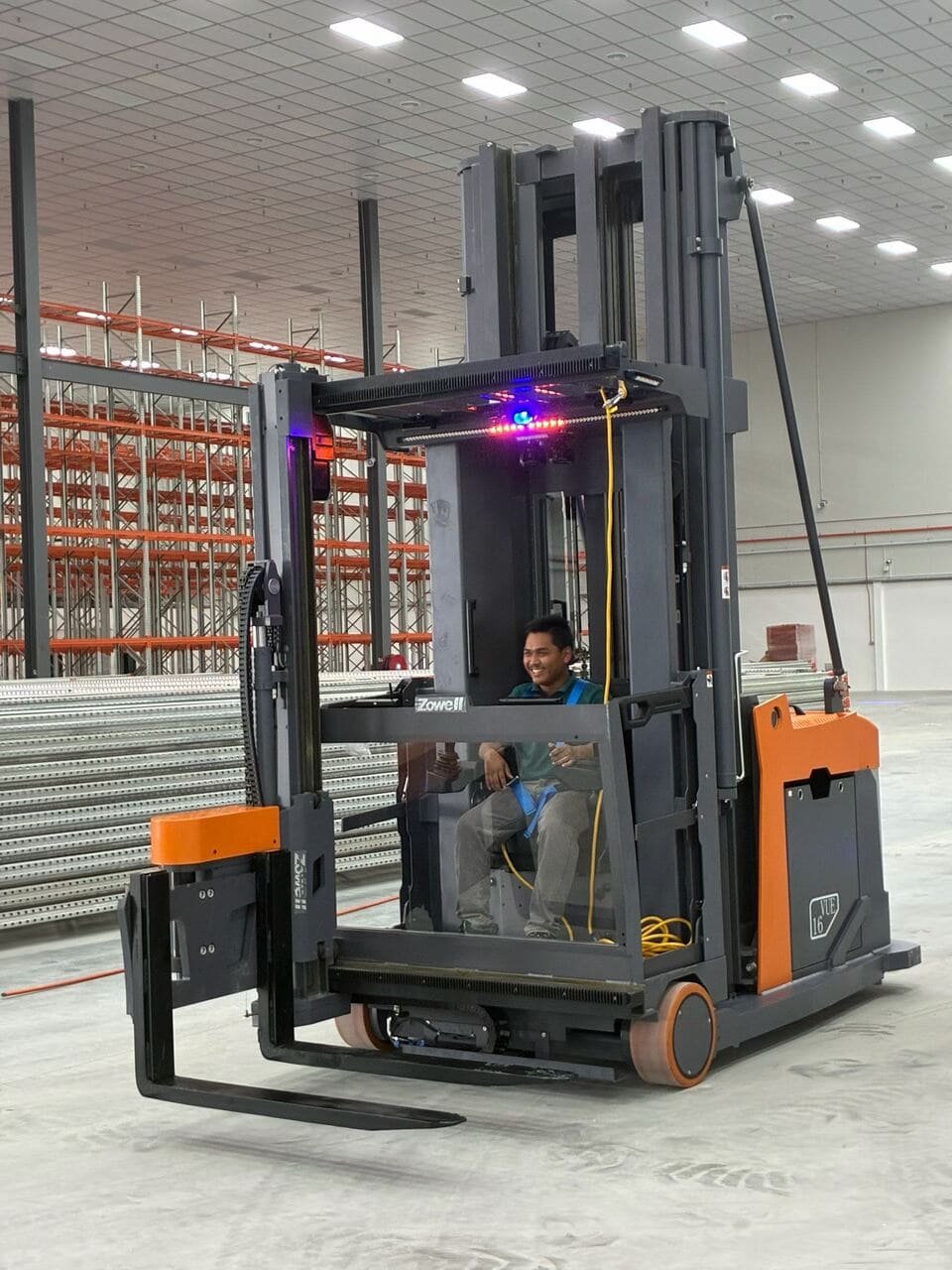
The turret truck is core equipment for narrow-aisle, high-density warehousing, and driver training timelines directly impact warehouse project launch schedules and staffing costs.
Turret truck operators must master specialized skills such as fork-head rotation, lateral movement, and high-level precision alignment. There is no universal standard for training duration — it depends on three key factors: trainee background, equipment characteristics, and operating conditions.
I. Training Duration Differences by Trainee Background
Depending on the trainee's prior experience, the training period required to reach qualified operation varies significantly.
1. Licensed Conventional Forklift Operators
Operators already familiar with general forklift driving principles and safety standards only need to learn turret truck operations and guided system usage. They typically need 1 week to pass the basic operation assessment, while achieving proficient operation requires approximately 1 month of on-site practice.
2. Trainees with No Prior Experience
Beginners must start with safety regulations and basic driving before progressing to specialized skills. A complete basic training cycle takes approximately 3–4 weeks, while proficiency in high-density aisle operations typically requires 2–3 months of hands-on practice.
3. Trainees with Narrow-Aisle Experience
Operators switching between similar models only need to adapt to the new operating logic and parameters. They typically require 1–3 days to complete adaptation and assessment, enabling rapid deployment.
II. Equipment Operator-Friendliness Is Key to Shortening Training
Among the factors affecting training efficiency, the equipment's operating design and assistive configurations are key variables.
When the operating logic aligns with conventional driving habits and is paired with guided driving modes, the learning curve becomes significantly shorter, reducing training time at each stage. Conversely, equipment that is difficult to operate not only slows onboarding but also increases operational risks during the learning phase.
Zowell Intelligent Forklift, a Chinese manufacturer specializing in narrow-aisle material handling solutions, equips its turret truck series with a standard aisle-guided assistive driving system. Travel paths are automatically guided by reference baselines, eliminating the need for constant steering corrections.
Fork positioning features laser alignment and HD cameras, while the overall control logic follows conventional forklift operating habits, making the equipment easier to handle.
These features help shorten the hands-on adaptation period for trainees with no prior experience while minimizing operational errors and associated safety risks during the learning phase.
III. Equipment Selection and Training Optimization Recommendations
There is no fixed answer to how long it takes to train a turret truck driver. The duration depends on the trainee's prior experience, equipment characteristics, and operating conditions.
Choosing equipment with strong operator-friendliness and comprehensive assistive systems can lower the hiring threshold, shorten the training cycle, and reduce safety risks during the learning phase. Over the long term, it can also help control labor costs and operational risks.
Mature models from specialized manufacturers like Zowell, featuring guided-assist systems and operator-friendly designs, are an important consideration in warehouse equipment selection.
For warehouse operators looking to shorten staffing lead times and reduce training costs, prioritizing equipment with high operator-friendliness and comprehensive assistive systems is an efficient strategy.
Zowell's mature turret truck solutions help lower the learning barrier and accelerate operator onboarding, better aligning workforce preparation with warehouse project launch timelines.